The Physics Series Volume 2: What’s my Angle?

Often when I’m dealing with clients (or even other trainers) and start talking about things like moment arms and force angles or resistance profiles I get a blank stare.  I understand that because I’m a geek and like to learn about things like this, just like I would give someone a blank stare if they started telling me about their ’68 Ford and how they replaced the carburetor.  Different strokes for different folks.

So when I’m working with clients and start adjusting things often I get asked why I’m doing it.  Something as simple as changing an angle during a movement can provide a totally different exercise experience not only for the person involved, but more importantly for the muscles and what you are trying to do to them.  A change as insignificant as 10 degrees in the knee during a knee extension depending on the position of the person’s hips can change the amount that a muscle is getting stimulated in ways that you might not think.  I’m not going to get into details, but if you want to take a look at THIS study go ahead as an example of what I’m talking about.  If you’re really keen I can direct you to about a few dozen more covering similar topics.  Another example when dealing with shoulders is that at a certain angle of shoulder abduction (like a lateral raise) the deltoid isn’t working as the primary mover, and then all of a sudden it is.

For our purposes we can call an angle as the measure of a rotation (or an amount of rotation) around a fixed surface – that being your knee, elbow, or finger joint.  In the strength work we take this to mean what angle one joint is achieving most often.  For example, “going to parallel” generally means that the angle of the thigh relative to the floor is parallel, but some people also take this as achieving 90 degrees in the knee joint.

So here’s the major question that most people are asking right now – why the heck does this matter in my exercise program?

I have clients ask me all of the time how they can change up their workouts, and this is one of the simplest ways to change a fundamental movement pattern and make it do something just a little bit different to the joints in question.  In RTS we call this “rotating the tires”.  For example, doing a flat bench press, or a 45 degree incline press stimulate the shoulder joint (and a few others) in different ways.  A pull down from straight above is different than a pull from in front of you.  All of the muscles that cross the joints are still moving and being stressed – just in different ways.

Angle also can contribute a lot into how much force is required to move an object.  Example – bicep curl.  When a curl is at 90 degrees the force in question on the bicep muscle is potentially twice as much as it is when the elbow is at 30 degrees (towards the end of the movement).  This also has to do with how far the weight is away from the joint in question like I discussed in my previous article about distance.  Suddenly a ten pound weight is now a twenty pound weight and can start to cause a problem for the person moving it or put more force into their joint than it can handle, causing tendon and ligament damage.

With something as complex as a back loaded squat, there are many angles in question.  The ankle, knee and hip joint all have to move together along with achieving a certain angle in the back, the feet and legs in order to provide not only safety but the ability to provide force along a chain that makes sure the muscles are being used to their maximum capacity.  The ability to maintain an even hip and knee angle is essential for deep squatting, and then if the whole chain is limited by the ankle joint it will throw everything off and you won’t be able to go as deep, therefore not providing as much stimulation or even tracking into injury.  There is a reason that people who have heavy loads on their back often do quarter range squats – because they simply can’t create the force to move the weight if they are at a certain angle.  Here’s an illustration:

Better squat angle.

Better squat angle.

Here's a restricted squat angle.

Here’s a restricted squat angle.

Simple things like achieving a larger range of motion during a movement can actually alter your exercise in a very significant way.  One of the reasons that I’m all over my clients during workouts is because there is simple intention behind every exercise, and if it is performed differently, or with sloppy form then we can’t accomplish the goal for that particular exercise in the way it has been designed.  This simple squat illustration can also show us where a person might be restricted due to something else and allow us to alter the current workout to help, not hinder progress.  Imagine in each diagram what the different forces might be on the ankle, knee, hip and spinal joints.

A person’s physical structure can also have a lot to do with this.  A person with longer levers like a basketball player would have a totally different movement path than someone a foot shorter and much wider like a powerlifter.  If my femur is longer then the whole movement changes again and I may not be able to achieve the perfect angle.  There is nothing wrong with that, but it does need to be considered when designing an exercise program.  Would an exercise like a squat be as “good” for someone who can’t achieve the depth they need to get to in order to stimulate what you are trying to stimulate?  Or would something else maybe be safer and more effective?

So here’s an idea – during your next workout, change a couple of angles of movement (while reducing load in order to be safe) and see if it doesn’t stimulate your body in an entirely different way.  I can almost guarantee that your body will thank you for the rotation of the tires you are giving it, and your experience will be much more fulfilling.  Feel free to report back to me and let me know how it went.

Anyone Can Kick Somebody’s Ass

If you have read anything that I have written in the past (and I hope you have) you know that I don’t have the highest opinion of my own industry.  In fact, to be blunt, my industry sucks.  Anybody who takes a weekend course and passes an open book multiple choice exam and then demonstrates that they know how to coach someone how to sit down and stand up gets a shiny piece of paper framed and can call themselves a certified personal trainer.

Now, let’s get some perspective here.  A massage therapist needs a minimum of two years of school and thousands of practice hours plus a rigorous examination process, and they massage people for a living (no offense to massage therapists of course).  A naturopathic doctor needs not only a bachelor’s degree with high marks, but also another 4-5 years of post-graduate training, and they consult with people about things like hormones, do food testing (often through labs) and perform skills like acupuncture.  Both of these things are something that requires a lot of knowledge and care.  Hell, it takes eight months of schooling to learn how to roll a cigar in Cuba so you can work in a factory.

cigar_rolling

So then why is it okay that a person with minimal education (often nothing beyond high school) and a weekend course under their belt can tell someone to get onto a treadmill and run until they throw up, or lift so much weight that they can be severely hurt?  Over my years as a trainer I have heard of (and witnessed directly) some of the most idiotic things that anyone could possibly do to someone, all in the name of “pushing through the limits” or “feeling the burn”.

There are many scary aspects about the fitness industry, but one of the most prevalent to me is that clients who hire trainers (especially at chain gyms, where trainers are often assigned by a salesperson who wants commission, not chosen due to qualifications) don’t do their due diligence, don’t bother to qualify the person they work with and just blindly trust that they are knowledgeable enough to not do anything stupid.

Here’s a quick clue:  it takes no skill at all to be able to turn someone into a quivering mess on the floor.  If I make someone lift enough weight, do it too fast, too soon and too often or put them on a treadmill and make them throw up a la The Biggest Loser this is not skill.  It is a person (who is being paid to care for another person’s body) treating you like a toy with no responsibility whatsoever.  Even better are the trainers who still believe in the “no pain, no gain” garbage mantra so if you aren’t sore (where they perceive you should be sore) they think they have done something horribly wrong and double the load during your next workout, crippling the poor person and ensuring that they won’t be able to work out for another week.  Great job.

Here’s a quick clue – your body is a lot smarter than that.  If you’re not sore, it doesn’t mean that nothing has happened to you and you aren’t going to get a benefit from it.  Anyone who thinks that not having DOMS means you haven’t worked a muscle is wrong.  Period.

So what does require real skill?  How about watching your client closely so that if their form goes off you can cue them back into proper movement?  How about stopping a set well before you need to so that they might be able to do a couple of more and learn a motor pattern without going into extreme fatigue?  How about progressing things carefully with loads specifically targeted to that person’s capacity on that day at that time, not necessarily what they should do based on a week ago?  How about when that person walks out the door, they feel better – not worse – than when they walked in because they are stimulated just enough to provide a good result without going over the edge?

It is not a badge of honour to not be able to walk up a flight of stairs after a leg workout or not lift your arms after an arm workout.  It is not a good thing to feel pain for three to four days (there is a big difference between pain and recovery).  It is not smart to give yourself goals that are potentially dangerous to achieve in a short time frame.  But these are things I see the fitness industry do almost every day.  And I would love that to change.

So if you’re a consumer reading this, please beware of my industry. That might sound strange, but it’s something I firmly believe in.  Do your due diligence and watch out for the uneducated and inexperienced trainer who is all about the intensity or creativeness and none of the skill.  I can guarantee you if you work out at a chain gym the personal training staff is probably 80% these types of people.

If you’re a trainer reading this, let’s all make a pledge to try to do better and use the skills that we have, or develop them if we don’t.  Honing a skill is something that takes years to do, and another person’s body, which you have now had the fortune (or misfortune) to be trusted with is in your hands.  It is a massive responsibility that you should never forget.

And, if you choose not to – you only need another 30 weeks of education to be able to roll cigars in Cuba.  You’re probably better off doing that anyway.

l

Physics Series Volume 1: Distance, Acceleration and Lifting Heavy Stuff

This series is designed to let people know about simple ways that physics affects their workout world and some simple concepts they can use to modify workouts or possibly even make them more effective and safer at the same time.  Yes, I admit I am in full nerd mode here but this is just how I get through the day.

Picard

meme haley joel

As trainers we talk a lot about tempo – or at least some of us do.  Some trainers think a tempo is an old type of car.  It is defined as “the rate or speed of motion or activity”.  To break this down further, it means velocity, and since in the fitness world velocity has a distance vector with something attached to it we can talk about acceleration.

Fundamentally this affects the amount of force your body provides onto a movement or therefore into a joint or series of joints.

What I want you to think about is the concept that the faster you want to do something, the more force is needed to move it taking into consideration the mass in question.  At that point, the actual weight involved can be part of the movement, but does not have to represent the entire situation.  For example, if you are bench pressing lying on your back and you lower the bar twice as fast with downward acceleration, the force required to reverse that acceleration and push the bar back in the other direction is possibly twice as much.

One of the fundamental theories in physics is that Force = Mass * Acceleration.  Acceleration is simply the change in velocity over the change in time.  This means, if I lift something at a rate of 1 meter per second, and take 1 second to do it, then the total acceleration is 1 meter per second per second, or in physics notation 1m/s2.  Say my mass is 100 pounds, then my total force is equal to 100.  However, how does this change suddenly if I decided to lift it faster?  Well, all of a sudden things change.

If I take the same weight and lift it at a rate of 2 meters/second over the same amount of time (1 second), then my acceleration is now 2m/s2.  What this means fundamentally is that I have potentially doubled the amount of force required for the joints performing the movement by performing the exact same movement faster.  So imagine if you will the impact on your body if you suddenly took the same amount of weight you were used to – and then doubled it.  Your joints might not be able to handle the strain and torque you were putting them under and your risk of injury would increase drastically.

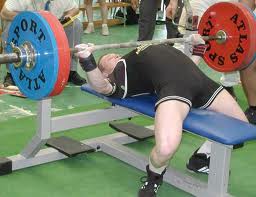
The factors involved here are distance travelled, the amount of mass involved (in our world we’ll take this as the amount of resistance) and also the velocity at which it is lifted.  A practical example can also be for that poor guy with the really long arms who wants to be a powerlifter.  He is certainly at a major disadvantage.  Why?  Because if he lifts a bench press bar up to his full arm extension he may have to move it many inches more than a really big guy who has relatively short arms.  In fact, the distance travelled may be as much as 50% greater.  This is part of the reason that powerlifters arch their backs so much, along with the fact that pushing from a decline position makes it easier to lift the weight.

Never mind the factors of muscle surface area and torque created around his major joints, he is all of sudden, if you take velocity and time into account he has to generate more force in order to move the same weight.  Also, there are other things to consider like his grip on the bar and the distance it travels from his shoulder.  However, if we do some quick math you will find that there are some astonishing things going on.  There is a reason why most successful power lifters are big thick people with really solid technique.

For our situation, I’m going to take a guy lifting a bar .30 meters from chest to full extension, and another guy lifting something .20 meters due to arm length.  They take the same amount of time to complete the lift (1 second).  The mass involved is 100 of whatever unit you prefer.  The first person has to generate a force of 30 in order to lift the weight.  The second person only has to generate a force of 20 – or one third LESS force (according to physics) in order to move the same weight over the same amount of time, purely due to distance travelled.  So the next time you see the guy with long arms pushing far less weight on a bench press, don’t be so quick to judge – he may actually be pushing far more weight in force terms than the big bulky guy beside him.

Powerlifter

So an easy way to apply this in the gym while mixing it up is to simply try to accelerate the same weight you have previously been using – but faster.  If you normally take two seconds to lift an object, try to do it in half of the time.  Your joints will take on more force even though you haven’t actually changed the mass in question.  It is a very simple way to change things, but can really be effective.

Please feel free to like, comment and critique this post and let me know what else you would like to hear about.  Until then, rethink exercise!

Choices and Consequences

This week Lance Armstrong will go on television and finally admit that he used performance enhancing drugs in order to win cycling races.  This is nothing new to most of us who already have known for a long time that he doped and most other professional cyclists did as well.  He just did it better.  In Tyler Hamilton’s recent book he basically explains that to make it in the sport it was totally necessary, and I understand that.  If you’re in a situation where it is either cheat and excel or stay clean and not place, it is human nature to want the reward.  I was in that position myself years ago and decided to go one way, but often wonder about what might have happened if I went to the other.  If you think that your professional athletes in whatever major sport you follow haven’t done something technically illegal at some point, I’d wager a lot of money that you’re wrong.

In the Fitness industry, competitors in bodybuilding and fitness competitions take drugs as well.  In fact, it is pretty rare to find any competitors at the top end of the sport that haven’t done it at least one cycle or take things regularly when they are finishing show prep, even though many of them will protest to the end that they are “natural” just like Lance did for years.  I have one colleague who at least comes out and admits about his drug taking and makes sure that he only competes in non-natural shows, and there is even a whole major federation out there that basically says everyone is doing it so they just turn a blind eye and don’t bother testing.  There are ways around any drug tests and it is remarkably easy to do so.  As a new competitor the temptation to just do it is huge, especially when coaches and trainers encourage it and will readily find it for you because it means you will get better results (which for some reason is their doing, not the drugs).

Many people don’t think about the long term effects of these things.   The body is only meant to be pushed so far, and when unnatural means are used to push it further then it usually fights back.  It isn’t unusual to see former athletes a shell of themselves a decade after they retired with a host of major health issues.  So athletes need to ask themselves if it is worth possibly dying ten to twenty years earlier because they decided to excel for a couple of years.  If there is huge money involved, like in Lance Armstrong’s case then most people would say no question.  But for that bodybuilder or fitness model, the only thing they are going to get is a trophy, maybe some nice pictures and a line on a resume.  It almost doesn’t seem worth it, but for many people it definitely is, even if they only win one show or achieve a “pro card”.

So then we come down to the moral question.  Is it really cheating if everyone is doing it, it seems to be tolerated by the vast majority of an industry and they are only going to condemn you if you get caught?  The temptation is experienced by athletes in all sports, and starts as early as high school for many teenagers.  Many out there would say cheating is cheating – it doesn’t matter if everyone else is doing it or it is almost required as it is with most professional sports to achieve that level.  But for anyone who has reached for that brass ring and just barely missed, having the chance to have that big moment of victory is usually too much to bear and they will do anything to get it again.  Our society rewards the winners, not the participants.  So it is perfectly natural for us to say “everyone is doing it, so why don’t I?”  It is human nature to want the satisfaction without considering the long term consequences.  We see this in marriages with affairs, workplaces with stealing and things like starvation diets and medical weight loss programs.

I have no problem with Lance taking drugs.  He did what was necessary and I’m not condemning that.   If he had been the only one doing it then the story might change, but he basically had a level playing field and beat everyone anyway.  He trained very hard and busted his butt, just like many people do in my industry.  However, the penalty is now catching up with him.  What people have to ask themselves now is whether it is even worth it to level the playing field for what you want to do?  Be aware that if you are going to take the risk, you have to expect that at some point you’re going to have to deal with the consequences, which often come well after the reward has been and gone.  There are examples of that all around me and to this day I look back and know that I made the right choice – for myself.  I hope that you decide to as well and live well with whatever choice that you make.           Image