
Tagged: pilates
How To Get Results – A Tribute to Russell P
It’s never nice when a client has to stop working with you for whatever reason it may be. Recently I found out that one of my long term clients, Russell P had to move to another city. I thought as a result I’d take the opportunity to write a quick tribute to him, because the way that he approached his training made my job really easy, but can also serve as an example to anyone out there who wants results on how to get them with some help from a trainer if you feel you need it.
Listen to and Trust your Trainer
When Russell and I met, he had been training for a marathon and managed to get Achilles Tendonitis. At the time I was working for a chain gym and he asked for someone with a running background and who knew about injuries. As luck would have it, I do well with both. At our first meeting Russell outlined his training program and one of the first things that I did was cut his mileage in half immediately. Now, Russell had eight weeks before running his first marathon so he thought I was crazy.
But, he listened. We strengthen and mobilized his ankle and got him back into a regular running rhythm and eight weeks later he completed his first marathon. It wasn’t fast, but it was done. Russell was simply trying to do too much too soon and his body was fighting back – quite common with runners.
Two years later running the same race (where he beat his old marathon best by over 30 minutes) we had a goal established that he probably could have tried to push more, but he chose to listen and just hit the numbers we had talked about, which is what brought him success.
Russell could have easily done something else or told me that he was doing what I asked and done something else, but that’s not like him. He has always trusted in the process. We do get input from each other, but the whole point of having a coach is to have them tell you what to do to succeed.

Just Show Up
I can probably count on one hand the amount of times Russell and I missed a session with a last minute cancellation. Even if he was hung over, tired or just generally stressed he still always showed up. Sometimes we wouldn’t get the best out of him that day, but what we did was always better than doing nothing. Once he committed to a race, it was there and 100% done. Before he decided to leave we had his goals planned out into 2016.
He was also excellent at following his programs without overdoing it or doing anything silly. If we had an off day planned, he took it – or if he had to make up for a run he missed he put it there. He never did too much again after that first injury.
Over time we even learned that we had to factor in two weeks after any major race in order to let his body rest and gave him time to recover and do nothing for a while. This should never be a problem for any coach because all you’re doing is giving the body what it needs after a big performance, which is recovery.
My point is that 98% of any success is just showing up. Many time it would have been easy for Russell to text me and say he couldn’t make it, but his training and progress were a priority that he made time for and as a coach this is something that makes it a lot easier to get results.
Plan Ahead
Any good coach will be able to plan out a schedule for a client, but Russell was especially good at thinking ahead and long term. Not only would he plan for what he was going to do workout wise when he was away, he made it a priority or scheduled workouts with friends while he was travelling. His family lives in England and even when he was over there for a week he still got his workouts is because he planned what days he was going to do them ahead of time.
We also planned his race schedule year to hear with one big goal (last year it was riding a bicycle from London to Paris, this year it was a ½ Ironman triathlon) and didn’t change it. He already has his priorities scheduled into 2015 and is committed to the process. There are little goals along the way, but the main focus can’t be month to month – it was to be one event and I always prefer if it is an annual goal, not a bunch of them (maybe twice a year at most).
Doing this ensures that your focus is always on the main event you have prioritized. It doesn’t mean that you can’t do a 10k race on your way to a marathon goal of course. And that brings me to my final point:
Roll With The Punches and Be Realistic
Sometimes life gets in the way. Russell and I at the beginning of the season had a ½ Ironman triathlon scheduled for the end of his race season (his first). However, the way that the summer fleshed out and with many work and life changes we both mutually agreed that it wasn’t a good idea to push for the distance when the training he was able to do would have resulted in a less than 100% result. He still completed his first Olympic distance triathlon with flying colours and hit all of his goals along the way.
Sometimes you need to assess if your life can really manage to get you the training that you need. I run into this quite often with fitness competitors who have jobs, families and lots of stress and have a hard time sticking to things. Health and well-being in my opinion should always be the top priority, and things like races and shows aren’t going anywhere any time soon. If you have to put a goal off temporarily due to something getting in the way – do it.
Want to do a ½ marathon but couldn’t get in your long runs? Try setting a PB at the 10k distance instead. You can still get a fantastic result and maintain your training and health, while also lowering your stress at the same time and taking pressure off so that the training that you can manage to get in isn’t wasted.
I hope that this brings some perspective into your own training. I’ll miss working with Russell on a regular basis a ton (we’re going to work together coaching virtually in the new year), not only because we have had a great relationship face to face but also because of all of the reasons labelled above that makes doing my job well so much easier. If you have a trainer take a look at the list and maybe there might be one thing that you could honestly say you can step up and improve a bit. I’m sure your coach will thank you for it and be able to get your results to you that much faster.
Also, if you’re reading this and are interested in coaching, my virtual services are available for the month of December at a 20% discount – five months for the price of four. Contact me for more details. Have a fit and healthy holiday season!
Sometimes, Strength Can Be Simple
Often my first few encounters with people are met with trepidation and fear. These are people who are injured, and have been for a long time without getting any type of improvement or change in their condition and they are tired of it, or often have just resigned themselves to feeling a certain way for a very long time.
I’m of the opinion that if you do the right things to tissue, it is a living thing and it can change to adapt and get stronger given the right stimulus. I’ve managed to prove this to myself and my clients over and over again through the years by giving their tissue exactly what it needs – more capability to handle stress under load without overtaxing the nervous system and causing pain, which is more often than not a defense mechanism or warning sign that something isn’t quite right.
My most recent example happened just two weeks ago. I began working with a woman who has had what was diagnosed as “tennis elbow” (by a sport medicine doctor) over nine months ago and has been living with daily pain since. She’s been doing physio weekly and has had not one, but two trainers working with her as well. She was actually referred to me by a colleague in another city after moving to mine.
So I’m doing my assessment and taking a very careful look at her elbow and notice that there seems to be a lot more laxity in the joint than on the opposing side. Her shoulder, elbow and wrist were also quite weak and unstable (unable to hold force without deviation) on that side. So as a result I spent a lot of our first full session together increasing her elbows’ ability to hold position, and also did a movement designed to apply force directly through the radioulnar joint into the humerus. Isometric elbow extension, limited range elbow flexion, and finally a simple direct push isometric into the joint with a lot of force. Result? Immediately after a simple 20 second isometric application she stated that it felt “better – strangely better” as she proceeded to fully extend her elbow (which she couldn’t do 2 minutes previous). As we proceeded with the rest of the movements things continued to improve.
Three days later she said that she had slept through the night previous, something she hadn’t done in months due to pain, and suddenly her elbow was a lot stronger – strong enough to do weighted pulling movements, which is something else she hadn’t done in months. All from a very simple – but deliberate and intentional – application of force to an area.
Now two weeks later we can do upper body pulling movements with load – something she couldn’t do two weeks ago and was afraid of doing when she walked into my studio.
Here’s the thing – if a wall is falling down, do you let it fall part way, then stop it there and start repairing it? No. You shove it back into place and then put a bolt in it so that it doesn’t fall down again. That’s strength.
So many people have a misconception that strength means that they have to move a boulder or throw something over their head. That they will get big and huge overnight if they even look at a weight. To me, strength is the ability of the body to hold onto force through its’ varying joints without causing trauma that causes that tissue to degrade. If you can move a bit more force through that joint (picture your knee during a knee extension) without the joint being compromised and losing the ability to hold position – that’s strength. If you can run 500 meters further without causing your legs and back to degrade to the point that you slouch or start striking with the wrong part of your foot – that’s strength.
Stronger tissue also means shorter recovery times, meaning you can either train more or train harder. Stronger tissue means that simple everyday tasks don’t have to cause you pain due to a joint going way too far out of its’ appropriate range of motion. The great thing about your body is that if you stimulate it properly with just enough force, it will adapt. Every single time. And, it is so intelligent that it will learn how to deal with that level of force by laying down more tissue in order to deal with the requirements being put upon it.

The greatest thing about this concept is that you can literally apply it to anyone. Have an elderly relative who can’t lift a grocery bag? Find a way that they can lift one that’s half or quarter full, or weighs 3 pounds. Then, once they can do that, add a pound. On the flipside of that you might have an athlete who can perform explosive fast movements for 45 seconds, but needs to be able to do it for 60, or maintain strength after being on a basketball court for 35 minutes with little rest. Find out where their threshold is and take them just a little beyond (if they can handle it at the time) and then the body will do the rest.
And for pete’s sake – if you are dealing with a professional who isn’t working towards resolving the problem and still throwing money at them – stop it. There’s a thousand practitioners out there in my city alone. I’m not saying that I have all of the answers, but sometimes what is done to people in the name of “therapy” makes me shake my head. Here’s a very simple statement: If your practitioner can’t tell you what they are trying to do to make sure your problem resolves and doesn’t happen again – every time – then find someone else who can.
And the next time you’re in the gym, or on the field, think about what you did last time. Then do more.
Overweight Teens Helped by Weights and Cardio – And Man Lands on the Moon.
A recent study in the Journal of American Medical Association Pediatrics found conclusively that for teenagers between the ages of 14-18, a combination of weight training plus cardiovascular work is the best way to “fight teen obesity”. This is the headlines that went up all over the country and internet saying that the amazing findings of this study were that if teenagers did strength training and cardio work combined instead of just one or the other, they would lose more weight.
This is news?
I hate to say it but that was my first reaction. However, when I took a closer look at this study I found that there were in my opinion some flaws in the methods used to determine this conclusion.
Basically this study, which you can read HERE took 304 overweight teens and put them into four groups, one of each doing only strength training OR cardio, one doing nothing, and one doing a combination. They did this program for 22 weeks (almost six months!). They were also given diet counselling. At the end, the group that did the combination of both was found to have lost less body fat overall (compared to the strength training group), but their waist size decreased the most – by a whole centimeter. That’s not even one whole pant size.
Therefore this shows that a combination of aerobic exercise and strength training is better than strength training alone or cardio alone. Again, this isn’t news to anyone (I sincerely hope). This has been proven time and again to be the best approach for those of you out there who are looking to drop inches and pounds.
But when we look a little closer, the criteria for what they consider “overweight” has some flaws. They cited overweight as at or above 95th percentile of BMI or 85th if there was one or more risk factors or health condition already existing (like diabetes). So this means that a teenager with a BMI of above 28.5 (the cutoff for 95th highest BMI percentile according to statisticians) is overweight or obese.
Do you know what that means? An 18 year old who is 5’10” and 180 pounds qualifies for this study as an “overweight teen”. A BMI of 24 actually falls into the 85th percentile of qualification. So if my daughter is 5’3” and weighs 135 pounds according to this study she is overweight. Oh, and another note – when she turns 18, even if she is the same height and weight suddenly she has dropped to the 74th percentile. Does that make sense?
Pretty much any athletic teen is going to weigh at last that much and sometimes more. Using BMI as a method of overweight is a highly flawed criteria in my opinion. There’s a lot of other flaws. They obviously weren’t all following the same diet. Who knows how many workouts they actually completed on their own. It didn’t indicate if any of them were athletes previously, inactive or high level performers. It wouldn’t be much of a stretch for a 16 year old football player to be 5’8 and 160 pounds but have very low body fat and high muscle mass.
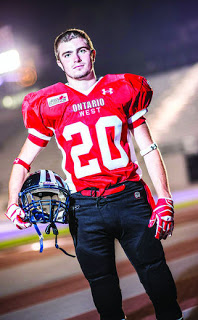
This football player is overweight according to this criteria.
So this made national (actually international) news because we heard about it up here in Canada. I guess it was a slow news cycles, what with war in the Middle East and a deadly epidemic spreading around the world.
The simple fact is that kids today don’t get enough exercise. Currently 59% of adults in Canada are overweight or obese in Canada (as of 2012). We can blame a lot of things here. Increased screen time, lack of physical education and after school sports programs, deteriorating nutrition both at home and at school and simply the fact that overweight parents tend to have overweight children because kids learn many things from their parents, not the least of which is eating habits. The medical industry unfortunately can’t or won’t help because many doctors have no clue about proper diet and exercise habits themselves. Many doctors I have worked with or attended have been relatively clueless about these things because it really isn’t their job to know about it even though they are expected to.
However, if you do have a young teenager or someone younger at home then the good news is you can keep their weight down. Guess what’s a great way to get both cardio and resistance exercise without a gym?
Sports.
Whether your kid is an individual sport kid (like I was – I ran track, did cross country skiing and played all racquet sports) or a team sport kid (like my sister who played basketball and hockey) there are a couple of dozen options available for each type. And even if the cost is prohibitive to a budget for things like hockey, there are tons of community resources available in any city for parents who want affordable exercise for their kids. Even something like martial arts isn’t ridiculously expensive, teaches really great fundamentals of coordination, discipline and uses lots of strength at the same time. Finding time as a busy parent can be hard, but what’s the priority – a healthy, happy kid or a promotion at work?
The sad thing is that I have trained kids as young as 8 and 10, and they could barely balance enough to walk slowly on a treadmill. Kids just simply don’t learn these things when they are developing any more. I could go on a rant about parenting and education these days but I’ll save that for another time.
So if you have a teen that is struggling with weight, maybe a good option is to get them to put down the Ipad, register them for a few sports or activities to see what they enjoy doing and get them being active and moving around more. Long term they will be much better off for so many reasons. Maybe even do it with them if you need help as well. Things like martial arts or even group exercise are easy to do with your teenager. Take your kid for a run or a bike ride on the weekends instead of staying inside. Take the whole family out for a long hike without any technology.
Like I said at the beginning, it isn’t news that kids need more exercise, or that a combination of things is likely to help them lose that extra centimeter. But it starts with actually getting them involved with exercise.
Feel free to comment, subscribe and share this post.
Case Study: Chris D
Often I have cases come into my practice where they stand out as a good example of what appropriate progression can accomplish. Also, frequently I get people asking me: what do you do with people? What is your secret to helping people get pain free and strong? I thought this case might be a good example of both and allow me to share some of the principles that have brought me success with people like Chris D. While this is an extreme example of a case, it might help give you insight as to what proper progression and intention can accomplish.
Chris started working with me ten weeks ago. He came to me through a referral described as a “back problem”, which I quickly found out was a bit of a loose description. I can’t obviously share what his scans MRI revealed but needless to say they were detailed and he had a lot of spinal issues stemming from a long career as a contractor. The biggest problem with our initial assessment was a pretty glaring one:
Chris couldn’t sit down. He couldn’t sleep for more than about an hour without waking. He couldn’t work without constant pain in his neck and shoulders and legs. Even driving his car was an exercise in pain management. Due to the pain in his neck, upper back, shoulders, lower back and legs after just sitting in my office for five minutes he was uncomfortable enough to have to stand up. No matter what I tried to do in order to check movements through his upper and lower body he was in pain, and it would flare up at the slightest bit of movement or force. Even isometrics, which is usually the most minimally irritating to most people was really irritating to Chris. I’ll share later what we have found out during the course of his treatment but needless to say it was a very daunting task.
For only the second time in my training career (and you can read about the first HERE) I was faced with a situation where I wasn’t 100% sure if I could help. Chris expressed that his previous physio experience left him feeling better, but of course things came back once he stopped because he didn’t have strategies to keep helping himself after he was done. This is all too common – physio can help to an extent, but then it takes getting stronger to really complete the rehabilitation process.
Initially Chris decided to give me a two week period to see if what I was doing would help a bit. Here’s a layout of how our first movement session worked (I keep notes on everything I do with every client so this is directly out of my notes):
- Priorities: Mobilize upper neck C5/6/7, upper trap, R side shoulder blade, strengthen L side upper quadrant. Standing mobility in L side hip com/glute com/lower back, strength in R side glute/hip coms and ankle on R side. (this was all based on what I could assess)
Release therapy was done on his upper trap areas on both sides to bring blood flow into the area and expose him to self myofascial release that we could do on his own with a ball. There are varying sizes of these and we used the largest one in order to have the largest surface area and the least access to deep tissue. Chris could not stretch conventionally because any movement would cause his pain to flare.
We started with a manual two legged hip hinging movement with about 20-30 degrees of hip and knee flexion (with a base for support that was 30 inches high as a guide) for control and teaching how to use his pelvis. My initial goal was to work on getting him sitting down (to help with work and being at home), then lying down (to help with sleep). We did some R side isometric engagement (while standing) for his glute and hamstring. We did some standing brace work to teach his inner unit how to engage properly and worked on his walking gait. One major discovery we did right away was that if he flexed his L shoulder 20 degrees forward while walking his pain diminished significantly through his neck and upper back.
After 35 minutes we had to stop because Chris was getting major irritation in his shoulders and neck.
Using proper microprogression and trial and error Chris was able to sit down in his car so that he could drive to his father’s place 1 hour away for Father’s Day in June, about five weeks after we started. His sleep was still an issue and his shoulders and neck would still get irritated quite easily, but through constant self therapy and working on movement patterns we had established on his own, things started to improve. Chris started to experience periods of time without neck/shoulder pain. Through more trial and error we found that if Chris rotated his shoulder blades a certain way he experienced relief. Being mindful of all of these things kept him encouraged and improving.
His lower back and legs started to improve significantly and we introduced compound movements. After the eight week point we discovered that his thoracic spine was likely twisted and began to work on that aspect, which helped quite a bit. Chris discovered that when driving (which he could do at all previously and now could do for extended periods) if he consciously kept his shoulder blades even he could eliminate pain in his neck. By now Chris could squat (with load), split squat, flex his shoulders almost to 90 degrees and even hold his spine against rotational torque.
After ten weeks Chris could deadlift 60 pounds with perfect form. I have a video of it but Chris asked that he remain relatively anonymous.
He has been getting proper nights’ sleep and been able to do more driving for work. He has been able to do work around his home that would have caused serious problems three months ago. Here’s a layout of our most recent workout:
- Alpha Ball warmup – mobility in rotator cuffs (both sides), one legged balance and thoracic spine mobility. Blood flow increase to VL/IT Band fascial line on R side (since doing more with his legs he started to experience some weakness through this area on his R side).
- Dead Lifts starting at 50 lbs and increasing to 60 (he holds the bar in external rotation because his shoulder is able to maintain in that position) for up to 9 repetitions.
- Lying position shoulder flexion with 3 lbs load on both sides maintaining position above 20 degrees from floor (through various positions we found that he is able to use front delt/pec/serratus in this position)
- Single Legged Leg press at 90 lbs of load (does not affect his lower back or hip complex any more)
- Eccentric loaded row in an incline position (I would have to take a picture of this for you to understand but think about lowering through a chest press focusing on the negative portion only)
Chris had made phenomenal progress over his time so far seeing me for only two hours per week. He also does a lot of work on his own, which is what I expect from my clients. He is aware of what he needs to do (and not do) and every time he comes in we have some new insight into a movement pattern that he experienced and we are able to build on that. One thing I constantly express to him is how I love the fact that he wants to understand what is going on and focuses constantly on moving properly. Chris has invested in his recovery, which is vital to any progress you want to make physically. It doesn’t happen slowly, it happens with careful application and time.
So here’s a good example of how a properly progressed strength program can help someone that has been in chronic pain for a long period of time. Many people walk around in situations that can easily be diminished or resolved through a properly progressed program with lots of intention and appropriateness. I’m hoping that Chris will continue to improve. One of our major goals was achieved last week when he actually slept properly, something he couldn’t remember doing for a very long time. These little things can make a huge difference to someone’s quality of life.
If you have any comments or questions about what I have been doing/have done with Chris please simply ask and I will share it (with his permission of course). Also, if you have any people who you think could benefit from the type of treatment Chris has gone through feel free to let me know.
Until next time – keep moving!
 Therapy and Exercise Refined