
Tagged: crossfit
The One Key to Results
Having been in this training profession for almost fifteen years, I’ve dealt with hundreds of people and helped them get healthier, stronger and feeling better about themselves. I’ve helped people lose 100 pounds, complete Ironman triathlons, recover from what they thought were permanent physical conditions, and given people the chance to live longer. It’s a pretty awesome job.
I get the question all of the time – what’s the big answer? What’s the key to getting through my barriers, getting the body I want or achieving that big goal I have? My first answer is usually that goals should never really end. You achieve one thing and then you keep moving forward towards something else.
Lost the weight you wanted? Great! Now, work on using your new body towards something cool like climbing a mountain or taking up a sport.
Completed that race? Great! When’s the next one. Do you want to go longer, be faster or simply perform better overall?
Got through an injury? Great! Now, can you get better than you were before and make sure that injury never happens again?
But what is the big answer to all of these things? It’s actually one really simple word that when applied can actually guarantee that you will achieve what you want. I’m going to share this powerful word with you in the hopes that it will sink in and resonate and drive you today and tomorrow and from now on towards your goals. And it’s so simple.
Ready? You sure?
Here it is:

CONSISTENCY
This one little concept is what has created most of the success in the world. Thomas Edison when he was inventing the lightbulb (okay, he didn’t invent it but he did develop the first commercially useful one) supposedly made 9,999 mistakes. And he kept going. Athletes at a high level train for YEARS – daily – in order to achieve a high level at anything. Business people who are at the top of the game didn’t get there overnight or by fluke. They have many, many years of 7 days weeks, no holidays and sacrificing to make sure they get to where they want to be.
Most of us simply aren’t willing to do this. We want the easy way, we want it fast and convenient like everything in society has programmed us to be. We want to microwave, not slow cook. We want to get liposuction, not eat right and exercise. We want that text message or email response right away.
One act at a time, one simple little thing at a time – done consistently – ensures that you are always moving forward and inevitably one day you will get to where you want to be. Every workout, every time you cook a healthy meal or don’t eat something you used to, every time you set the alarm early you’re moving forward. And if you stay consistent and just don’t stop then you’re definitely going to get there. It’s really that simple.
Success doesn’t come overnight. It never has and it never will unless you believe in winning the lottery. Those people who are where you want to be got there through hard work and consistency, every time. Nobody was born with a perfect body, nobody was born with a million dollar business. Athletes train since they are children and never take years off.
A pretty simple concept, right? The hard part is applying it. So if you’re working towards something you really, really want (and that has to be the case otherwise you simple aren’t going to get there) just stay consistent. Whatever that means to you. For some of my clients it is once a week, for some it is several times – but they are consistent about it.
So start with the one simple step. A daily act or one small step every day no matter how small as long as it is consistent is moving you forward. And just keep doing it.
I hope this helped you. Feel free to share, like and tweet me out if you enjoy what I share with you and as always, if you have any questions or comments just share away. I look forward to helping you!
The Downers of the Downward Dog
This was inspired by a client of mine who wanted to restart yoga after a bad back injury.
What if, as a trainer I told you that we were going to do an exercise that did the following:
I want you to lengthen out your posterior chain as much as you can, throw both of your shoulders into extreme extension, put yourself into spinal flexion (even if you can’t properly tilt your pelvis) and stretch out your hamstrings and calves as far as they can go (thereby also yanking hard on your sciatic nerves) – oh, and do it while loaded with up to 70% of your body weight, and the load increases the further you get into the exercise. So for a 150 pound female that would mean their shoulders and knees are loaded in extension with up to 105 pounds on their spine and other joints.
Does that sound like a good idea for anyone, let alone people recovering from injury?
The funny thing is, people in yoga classes do this almost every day. It’s called a downward dog.
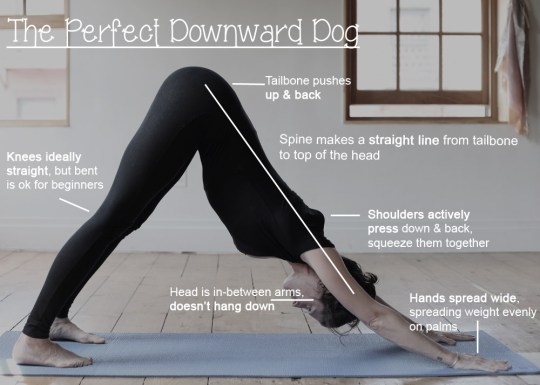
Now, before the yoga community absolutely freaks out and starts thinking I’m bashing the movement, I’m not. All I’m doing is providing a practical analysis of what people are required to perform to get into this position. I’ve had a client recently with severe back issues try to get back into yoga and the one movement she had immense trouble with (not surprisingly) was this one. I’ve also attended yoga courses where thankfully the instructors were aware of the limitations of this movement and realized that not everyone should perform a downward dog – in fact several of my most respected colleagues actively discourage it since they have realized what it does.
On the flipside I’ve also been to yoga classes where the instructors did absolutely NOTHING except for sun salutations over and over again. You can guess which class I didn’t go back to.
“BKS Iyengar, one of the foremost yoga teachers in the world asserts that this asana stretches the shoulders, legs, spine and whole body; builds |strength throughout the body, particularly the arms, legs, and feet; relieves |fatigue and rejuvenates the body; improves the immune system, digestion and blood flow to the sinuses, and calms the mind and lifts the spirits.” (ripped from Wikipedia) – and it does all of these things.
But what people need to realize as a whole is that some movements that you perform in a typical yoga class are very hard forceful strength movements. Simply because it is packaged as something healthy and therapeutic doesn’t mean that it is. Just like any other type of exercise, it needs to be tailored to the person participating in it. A 200 pound deconditioned person has absolutely no business getting into this position and here’s why:
Here’s what people need to be able to do into order to successfully perform this movement:
Put your arms overhead fully or even behind the torso while internally rotated. This requires a healthy rotator cuff complex, the rib cage to be able to move and the shoulder blade to be able to move with proper rhythm. One loaded movement I often have clients do to test this area is a loaded shoulder extension (think a front raise but over the head with a cable) at various angles in order to engage the entire shoulder complex.
Hinge the hips with proper pelvic movement so that the lower spine isn’t flexed forward putting strain on the lower spine with load – while it’s flexed. Think loaded Romanian deadlifts, and even things like good mornings (I have a bias against these because of where the load is placed but whatever). Just because your hands and feet are on the floor doesn’t mean there isn’t a ton of pressure going through the lower spine in this position.
Fully extend the knees and dorsiflex the ankles as much as possible – general limits here are thought to be 30 degrees but most people have much, much less than that. Generally here in a squatting position I look for the ability of the knee to travel forward properly and therefore dorsiflex the ankle. Can you squat low? Or does your person have longer legs relative to their torso? Are they recovering from a knee issue that might be contraindicated to full knee extension (like a meniscus injury?).
There can be many restrictions in this area and it also has the highest risk of issue due to the excessive load people will put on their knees in order to force themselves into a straight legged position. The restriction might also come from hamstrings, calves or somewhere else, not even the ankle.
So here’s my question: Can or should you do all of these things and hold them for time? No? Maybe this movement isn’t for you.
What people need to realize is that even though it is relaxation based and supposedly “stretching”, yoga is still force on joints. Sometimes a lot of it. Another common flaw of the downward dog is that people will generally run away from weakness. This means that if they are weaker in the shoulders and have trouble there they will dump more load into their lower body in this position. If they are weaker in the lower half they may dump more load into their upper body. I have seen this often in classes. And it can cause a serious problem if suddenly the load shifts by 20-30% into the wrong area suddenly due to a weakness somewhere else. However, due to the nature of the position there isn’t any way to get out of it. Except for compromising by say, lifting your heels or bending the knees or even elbows to put load elsewhere.
So what are some good modifications? Well, like in any other loaded position if you can take the load off a bit, then the person can attempt the range of motion without the excessive joint force. For example, a person with good shoulder mobility but poor posterior chain range and pelvic movement might want to perform a simple hip hinge with their shoulders extended and brace their upper body against something. Prenatal classes often recommend this.

Another option might be to intentionally elevate the heels and bend the knees as I expressed earlier. You can also bend only one knee or alternate sides. For less force on the arms and shoulders, lower the body and rest the forearms on the ground. These are all modifications that can easily be suggested in a class but often aren’t. During a busy class most instructors just don’t have the chance to go around and suggest individual modifications to people.
Or here’s a thought – don’t do it. There are ways to work up to this movement, just like any other yoga movements but so many people make the mistake of jumping in and following along, and then wonder why they are sore the next day and never want to go back.
The good news is that with my modifications to her positions and telling her to skip downward dogs my client successfully navigated two yoga classes and has been able to get back in touch with something she previously enjoyed but couldn’t do.
Don’t get me wrong, I’m a fan of yoga. I’m a fan of anything that keeps people moving, enjoying loaded positions to develop strength and will over time develop additional range of motion. I’m also a big fan of the relaxation side of the practice and allowing people to be in a parasympathetic state, even if it is only for five minutes at the end of class in savasana. It’s something most people should do a lot more of. The reason I’m writing this is to make sure that if you are about to jump back into yoga because you think it is a good way to ease into exercise again – it might not be depending on the class.
As always, if you have comments feel free to comment here or email me at paradigmfitnessottawa@gmail.com. Good luck with your future practices!
The Best Coaches Teach Fundamentals
As a trainer and coach I tend to read a lot of stuff written by other successful trainers and coaches in order to try to make me better at my job. Throughout the years there has been one main theme I have seen that I thought I’d point out to the rest of you, trainers and potential clients alike.
Newer trainers and coaches tend to think they need to reinvent the wheel in order to make themselves more marketable or stand out among the crowd. They try whatever the latest fad trend is with the hopes that it will cause the client to be impressed. Eventually (with any luck) they realize that a coach is only as good as their results. Doing something showy and flashy in order to create a temporary response is usually a sales tactic – anyone can push someone really hard, as I wrote about previously HERE.
This means whatever the client goal is they need to be working towards it and making constant improvement. For my strength clients, this is being able to generate more force or move more weight. For my running clients it is being able to run greater distances, faster or both. If you coach a sports team, then they should be increasing their skill levels at whatever position they are performing in and also hopefully using that to win games.
So what is the key? Throughout history of successful coaching, it really comes down to one word: fundamentals.
Successful coaches can make people better at things that they should already be doing well. For a strength coach, this can mean the basic lifts like squatting, deadlifting, pulling and pressing. For an athletic coach this can mean things like power, agility and coordination. For my runners, it means being more efficient with every foot strike, which in some cases means starting over again at the beginning.
Throughout the sports world, high level athletes will tell you that they spend hours upon hours practicing fundamentals. Basketball players practice foul shots. Cyclists ride their bikes for hours a day. Swimmers swim lots of laps. Baseball players take batting practice daily for hours. Often this has no major goal beyond building the fundamental mechanics or strength they need in order to improve.

Just two months ago I started working with a post surgery client who had recovered but had shin splints daily. When her basic walking gait was corrected and she started to use the proper muscles again the shin splints disappeared. The same thing tends to happen for back issues when the person learns how to deadlift and squat properly. Some trainers would call this “correcting an imbalance”. I’d rather call re-educating the client (and their tissue) on something they already know how to do.
Your body is a very smart thing. It learns based on the input it is given. As I always say, crappy information IN means that you will generally get crappy information OUT. If you overwhelm your nervous system from the get go it doesn’t have a chance to adapt and make improvement. This means spending weeks (for some people) practicing simple things until they have them down.
So what are the fundamentals? Well, it really depends on the person. For some people, walking properly is hard enough. Throw in a few activities of daily living like sitting down, picking things up and climbing stairs and they might be done. I’ve had to reteach these things to hundreds of people over the years, and more often than not when they are practiced and put into place little painful issues tend to resolve very quickly. Same with high level performers. Often with my athletes they simply need to be coached on how to perform a movement they have forgotten how to do properly. This can be as simple as a squat (for a powerlifter) or as complex as an ankle mobility movement for a soccer or football player.
Most movements can be broken down into basic primal movement patterns, which is echoed by both movement gurus and athletic trainers alike. Deadlifting. Pushing and pulling. Spinal flexion, extension and rotation. This is generally what 95% of my clients start with, even if it is completely de-progressed like a basic box squat within a range of motion their hips, knees and ankles can perform at without deviation.
In fact if you’re a reader of fitness magazines, you can see this plain as day. Any program that tells you how to get a BIG LEGS has a squat in it. BIG CHEST means lots of bench pressing. Not a one armed dumbbell press on a Swiss Ball. Stick to fundamentals and you are guaranteed to see progress. Another of my mantras is that you EARN THE RIGHT TO DO MORE. This means if you can’t do something basic you have no business doing a progressed version of it. Most high level coaches adhere to this.
If you have run into a coach or trainer who tells you that you need to perform some sort of elaborate system in order to improve a simple movement, maybe you should think twice. There’s a time and a place for breaking down movements to isolate weak points, but it should not be the primary focus of any workout. There always needs to be a goal, and in my opinion that goal should be centered around the fundamentals.
So the next time you read about some amazing NEW system that is going to explode your gainz please put down whatever article you’re reading (unless it’s mine) and go deadlift. Or do some pullups. It’s probably what any decent coach would tell you to go and do anyway.
Detoxification. Yes, it’s a scam.
Recently my Facebook feed has been flooded with yet another misleading trend designed by companies and people in order to try to make money off people who don’t know any better. This simple word is one thing: detoxification.
Detoxification doesn’t exist. It’s a garbage term for a garbage industry. And anyone who is trying to sell you on it is trying to make money off of you. Period.
This is nothing new. In past years people from companies like Isagenix, Herbalife, Juice Plus, Visalus, several other MLM companies and many, many over the counter products are always talking about detoxification. It’s a horrible thing that is definitely the cause of your headaches, bowel problems and weight gain. Take these products for 90 days and you will feel better, lose weight and remove all these icky things that have accumulated through your lifetime of bad choices.
Here’s a few simple questions to ask anyone who talks about this stuff and find out if they actually know anything about the word:
What does detoxification actually mean? (It’s a medical term)
What is a toxin? (Toxins are always referred to but never named by these people) – can they actually name any toxin that they are claiming to remove from your body?
What are the places you need to detox most? (If they say it’s the liver or kidneys then they don’t know what these organs actually do).
Can I detox myself without your products? (of course not, my product is the best way and is scientifically proven to work!)
I’ll be blunt. This is total quackery. But for some reason people keep falling for it. I’m not going to bother listing the amount of credible scientific entities that have proven this stuff is completely stupid and a waste of money, but you can easily find them. I have one here. And here. And here. And here. Which is the tip of the iceberg.
Most of the time these products contain two things: laxatives (put under natural names) and diuretics (also naturally based). You pee more and poop more, and suddenly you’re losing weight (imagine that). Plus, some very popular ones have you replace most of your solid food with shakes (that they provide) and suddenly you lose weight. Miracle!
You know how to make yourself feel better? Eat more fibrous vegetables and fruits. Eat less animal protein. Don’t take supplements unless you actually need to. Sleep more. Stop engaging in sympathetic behaviors like computers and cell phones all the time. Exercise regularly and intensely enough to create a positive hormonal change. This is all really easy to do, and it’s free except for a possible change in your grocery bill (and vegetables are cheaper anyway).
In fact, many of these products can create more problems than they solve. Throwing your body suddenly into a state of either caloric deficit or changing your diet radically can create issues like constipation, headaches or even severe reactions. All the things people selling detox would have you think is toxins leaving your body, not something created by the cure they sold you.
Recently a friend of mine who is highly educated (two advanced degrees) actually asked me if she should do a cleanse. You know what my answer is?
You don’t need expensive products. You need a carrot. And probably more water. Let your body cleanse itself, it will do a fine job if you give it the tools to do so.
Oh, and if anyone tries to sell you on this stuff, especially within the fitness or health industry, please walk the other way. They know it’s bullshit. They’re trying to take advantage of you and make money. My latest hat tipper is a former dental hygienist (and IFBB pro of course) who is now an expert on nutrition with no formal education and one year at a holistic nutrition school under her belt. Find me a girl or guy who has recently won a couple of fitness shows and likely within a year or two they will be pushing products like this – or of course, whatever supplement line they are sponsored by. With no credibility behind the products or themselves besides a shiny trophy. Welcome to another day in the fitness industry.

Again people, let’s be smarter than this. Like I always say about fitness, buyer beware. Don’t support an industry that is based on nothing but smoke and mirrors. And please, please, please check whatever educational background your current “detox” guru has. Odds are the only thing they are looking to improve is their bank account.
 Therapy and Exercise Refined