
Tagged: ottawa
Runner Coaching Special Offer for December
One of my jobs over the past 15 years has been coaching runners of all shapes, sizes and ability levels towards whatever goals they might have in the running world. I have coached Boston Marathon qualifiers, 1:30 half marathon runners, and many, many people towards doing their first race straight off of the couch as well as walkers. I’ve personally done two full marathons, over a dozen 1/2 marathons and every other type of race over the years.
My belief is that anyone can accomplish their goal given proper progression over time and appropriate stimulation of strength and endurance combined.

Ottawa Race Weekend on May 23rd, 2015 is one of the best races in North America, and offers every type of race from a 5k right up to the full marathon. Most years I have 1/2 a dozen clients participating, and I’d like to offer for you to join my client roster with some online runner coaching from January 1st right to Race Day.
The good news about this service is that most of it is done via virtual support, which can save my clients money and time – get all of the guidance you need to without having to come into the studio and train in person.
What is included with coaching:
- An assessment of your goals and current ability with a realistic goal setting strategy for your race.
- Weekly workouts programmed month to month with distances, paces and skill workouts outlined in detail (hill work, tempo work, interval work and others if needed).
- Adjustment allotted for treadmill users and cross training suggestions for people who don’t want to run all of the time!
- Constant feedback and adjustment to schedule if needed due to time constraints.
- Race Week and Race Day coaching including nutrition tips and course strategy – know exactly what you’re going to do before you do it!
- Support and follow up continually for the duration of your program from start to finish.
As a special promotion for Ottawa and the month of December, anyone who is attempting Ottawa Race Weekend (or any race in May) can receive coaching beginning January 1st up to and including Race Day (and afterwards) for only $299 plus HST. This is an incredible value for the runner in your life, or if you are even thinking about participating in Race Weekend (or doing another race in May elsewhere). Get your spring running fitness set right away in January!
If you want to see or contact references of past success stories or have any questions feel free to contact me through the web site or at paradigmfitnessottawa@gmail.com, or simply call me at 613-252-2972. I look forward to helping you reach whatever goal you are working towards.
Sometimes, Strength Can Be Simple
Often my first few encounters with people are met with trepidation and fear. These are people who are injured, and have been for a long time without getting any type of improvement or change in their condition and they are tired of it, or often have just resigned themselves to feeling a certain way for a very long time.
I’m of the opinion that if you do the right things to tissue, it is a living thing and it can change to adapt and get stronger given the right stimulus. I’ve managed to prove this to myself and my clients over and over again through the years by giving their tissue exactly what it needs – more capability to handle stress under load without overtaxing the nervous system and causing pain, which is more often than not a defense mechanism or warning sign that something isn’t quite right.
My most recent example happened just two weeks ago. I began working with a woman who has had what was diagnosed as “tennis elbow” (by a sport medicine doctor) over nine months ago and has been living with daily pain since. She’s been doing physio weekly and has had not one, but two trainers working with her as well. She was actually referred to me by a colleague in another city after moving to mine.
So I’m doing my assessment and taking a very careful look at her elbow and notice that there seems to be a lot more laxity in the joint than on the opposing side. Her shoulder, elbow and wrist were also quite weak and unstable (unable to hold force without deviation) on that side. So as a result I spent a lot of our first full session together increasing her elbows’ ability to hold position, and also did a movement designed to apply force directly through the radioulnar joint into the humerus. Isometric elbow extension, limited range elbow flexion, and finally a simple direct push isometric into the joint with a lot of force. Result? Immediately after a simple 20 second isometric application she stated that it felt “better – strangely better” as she proceeded to fully extend her elbow (which she couldn’t do 2 minutes previous). As we proceeded with the rest of the movements things continued to improve.
Three days later she said that she had slept through the night previous, something she hadn’t done in months due to pain, and suddenly her elbow was a lot stronger – strong enough to do weighted pulling movements, which is something else she hadn’t done in months. All from a very simple – but deliberate and intentional – application of force to an area.
Now two weeks later we can do upper body pulling movements with load – something she couldn’t do two weeks ago and was afraid of doing when she walked into my studio.
Here’s the thing – if a wall is falling down, do you let it fall part way, then stop it there and start repairing it? No. You shove it back into place and then put a bolt in it so that it doesn’t fall down again. That’s strength.
So many people have a misconception that strength means that they have to move a boulder or throw something over their head. That they will get big and huge overnight if they even look at a weight. To me, strength is the ability of the body to hold onto force through its’ varying joints without causing trauma that causes that tissue to degrade. If you can move a bit more force through that joint (picture your knee during a knee extension) without the joint being compromised and losing the ability to hold position – that’s strength. If you can run 500 meters further without causing your legs and back to degrade to the point that you slouch or start striking with the wrong part of your foot – that’s strength.
Stronger tissue also means shorter recovery times, meaning you can either train more or train harder. Stronger tissue means that simple everyday tasks don’t have to cause you pain due to a joint going way too far out of its’ appropriate range of motion. The great thing about your body is that if you stimulate it properly with just enough force, it will adapt. Every single time. And, it is so intelligent that it will learn how to deal with that level of force by laying down more tissue in order to deal with the requirements being put upon it.

The greatest thing about this concept is that you can literally apply it to anyone. Have an elderly relative who can’t lift a grocery bag? Find a way that they can lift one that’s half or quarter full, or weighs 3 pounds. Then, once they can do that, add a pound. On the flipside of that you might have an athlete who can perform explosive fast movements for 45 seconds, but needs to be able to do it for 60, or maintain strength after being on a basketball court for 35 minutes with little rest. Find out where their threshold is and take them just a little beyond (if they can handle it at the time) and then the body will do the rest.
And for pete’s sake – if you are dealing with a professional who isn’t working towards resolving the problem and still throwing money at them – stop it. There’s a thousand practitioners out there in my city alone. I’m not saying that I have all of the answers, but sometimes what is done to people in the name of “therapy” makes me shake my head. Here’s a very simple statement: If your practitioner can’t tell you what they are trying to do to make sure your problem resolves and doesn’t happen again – every time – then find someone else who can.
And the next time you’re in the gym, or on the field, think about what you did last time. Then do more.
Healing From Injury as a Country
I deal with physical injuries all of the time. Just like a physical injury, yesterday our country was affected emotionally and mentally by a coward who chose to murder an innocent man in cold blood and then attempt to do something horrible in the name of possibly nothing but stupid ideology. To be blunt, I’m happy he’s dead. I feel horrible for the family of the soldier who gave his life, and I feel horrible for the fact that one mentally disturbed person can change the feeling an entire country has towards safety. A lot of people are saying to just move on like nothing has happened and by not letting it affect us, we win the fight. But the reality is that it has already affected us, just like if one of my clients tears a muscle. There’s nothing we can do about that except to figure out how to deal with it and heal.
Driving into work today I was thinking about injuries. In the acute stage things hurt, which is a signal that something isn’t quite right with your body. In our society, obviously this disaffected person and others who create chaos in the name of a religious ideology have this symptom. Something isn’t quite right, whether it be their mental state, their background or just the fact that they don’t like normal society. And they lash out, which causes pain, sometimes on a large scale as happened yesterday. Sometimes it is on a smaller scale and we simply don’t hear as much about it because it only affects one or two people or a family, but the common symptom and result is emotional and mental pain. We cry out as a nation and clutch onto whatever area we feel is injured. It consumes us when we sleep. We cant ignore it because it is everywhere.
Then the acute stage is done, things calm down a bit and the evaluation process begins. As with injuries, the first reaction is full defense mode. We shore everything up just like the body does when it creates inflammation around an injury. We close doors, we cordon off areas, we stay home. We’re afraid that things might get worse. This is a normal reaction. We stop moving. It takes times for that inflammation to fully set in and for someone to realize what has really happened. We also try to diagnose what happened and why. It;s really easy for us to claim a cause, but fundamentally we just don’t know 100% what created the situation. Was it the chicken or the egg? Did that one jump that led to the trauma create the problem by itself, or did it take place over a period of months? We might never know. But we can look into it and look back and try to figure it out, because that’s what is going to help us figure out the healing strategy.
The next step is to figure out what to do about it, just like the state our city and society is in today after the event took place. For a lot of people with injuries, they live with it for a while or ignore it, which is often the worst thing they can do. It certainly doesn’t solve the problem and means that the person has to live with the effects of what happened, which can change how they move and think about their day to day life. Or even worse, they try to go about things exactly like they did previously expecting a different result or for that pain to not happen again. They think they are invulnerable. Nobody is. In order to heal, we need to take steps to help ourselves.
Healing takes a proper strategy towards two things. The first is to address the situation and deal with the area that was affected. For us in Canada, this means that we have to acknowledge that there are people in our society who obviously have enough issues that they decide to commit crime under the flag of hatred. They are out there, and there’s no question about that. However, we also have to realize that the actions of a few misguided people doesn’t represent a whole segment of our society. Just like if I perform a quick movement slightly wrong and cause myself to injure my back, it doesn’t mean that my whole spine is broken. It doesn’t mean that you have to suddenly put yourself in a full body cast and not move for six weeks. While it may feel that way temporarily, the simple fact is that it isn’t the whole picture. One person committing an act doesn’t mean that a whole group is bad, just like one exercise causing pain doesn’t mean that a machine is bad or good. It just wasn’t the right application. For some reason this person reacted differently to the way we live than what a normal person would. This doesn’t mean that a whole group thinks the same way or would react the same way.
The second part of the healing process is making sure that it doesn’t happen again. In the strength world we apply force to an area because we know that once it heals, it will heal stronger than before. Our society is the same way. Through the actions that we take from now on our city and country will be stronger because we’re finally going to apply things in a way that (hopefully) deal with the actual problem, not just the symptom. I’m not claiming at all to know what that is, but whatever it might be the process of healing remains the same. Maybe it is a new policy towards something, maybe it is increased vigilance towards certain movements and maybe it is both. The point is that we can heal, and once we heal we will be stronger than we were before. That’s certain.
So in my opinion here’s what we can do, just like I would do with a client. Deal with the acute symptoms, create a strategy, and what is most important is making sure that this doesn’t happen again. Life in general should be a continuous learning process, and we as a society can learn from this, as horrible as it sounds. Whatever your strategy is for dealing with this pain that we have had inflicted upon us, don’t ignore it and just move on with your life. Make sure that you evaluate and we can all take steps to make sure that this doesn’t happen to us again. That’s what will lead to true recovery as a nation.
Thank you to our military personnel who sacrifice all the time in the name of our country.
#ottawastrong

Overweight Teens Helped by Weights and Cardio – And Man Lands on the Moon.
A recent study in the Journal of American Medical Association Pediatrics found conclusively that for teenagers between the ages of 14-18, a combination of weight training plus cardiovascular work is the best way to “fight teen obesity”. This is the headlines that went up all over the country and internet saying that the amazing findings of this study were that if teenagers did strength training and cardio work combined instead of just one or the other, they would lose more weight.
This is news?
I hate to say it but that was my first reaction. However, when I took a closer look at this study I found that there were in my opinion some flaws in the methods used to determine this conclusion.
Basically this study, which you can read HERE took 304 overweight teens and put them into four groups, one of each doing only strength training OR cardio, one doing nothing, and one doing a combination. They did this program for 22 weeks (almost six months!). They were also given diet counselling. At the end, the group that did the combination of both was found to have lost less body fat overall (compared to the strength training group), but their waist size decreased the most – by a whole centimeter. That’s not even one whole pant size.
Therefore this shows that a combination of aerobic exercise and strength training is better than strength training alone or cardio alone. Again, this isn’t news to anyone (I sincerely hope). This has been proven time and again to be the best approach for those of you out there who are looking to drop inches and pounds.
But when we look a little closer, the criteria for what they consider “overweight” has some flaws. They cited overweight as at or above 95th percentile of BMI or 85th if there was one or more risk factors or health condition already existing (like diabetes). So this means that a teenager with a BMI of above 28.5 (the cutoff for 95th highest BMI percentile according to statisticians) is overweight or obese.
Do you know what that means? An 18 year old who is 5’10” and 180 pounds qualifies for this study as an “overweight teen”. A BMI of 24 actually falls into the 85th percentile of qualification. So if my daughter is 5’3” and weighs 135 pounds according to this study she is overweight. Oh, and another note – when she turns 18, even if she is the same height and weight suddenly she has dropped to the 74th percentile. Does that make sense?
Pretty much any athletic teen is going to weigh at last that much and sometimes more. Using BMI as a method of overweight is a highly flawed criteria in my opinion. There’s a lot of other flaws. They obviously weren’t all following the same diet. Who knows how many workouts they actually completed on their own. It didn’t indicate if any of them were athletes previously, inactive or high level performers. It wouldn’t be much of a stretch for a 16 year old football player to be 5’8 and 160 pounds but have very low body fat and high muscle mass.
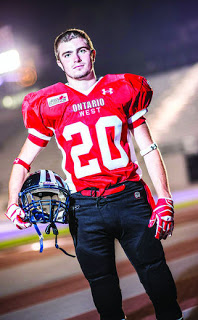
This football player is overweight according to this criteria.
So this made national (actually international) news because we heard about it up here in Canada. I guess it was a slow news cycles, what with war in the Middle East and a deadly epidemic spreading around the world.
The simple fact is that kids today don’t get enough exercise. Currently 59% of adults in Canada are overweight or obese in Canada (as of 2012). We can blame a lot of things here. Increased screen time, lack of physical education and after school sports programs, deteriorating nutrition both at home and at school and simply the fact that overweight parents tend to have overweight children because kids learn many things from their parents, not the least of which is eating habits. The medical industry unfortunately can’t or won’t help because many doctors have no clue about proper diet and exercise habits themselves. Many doctors I have worked with or attended have been relatively clueless about these things because it really isn’t their job to know about it even though they are expected to.
However, if you do have a young teenager or someone younger at home then the good news is you can keep their weight down. Guess what’s a great way to get both cardio and resistance exercise without a gym?
Sports.
Whether your kid is an individual sport kid (like I was – I ran track, did cross country skiing and played all racquet sports) or a team sport kid (like my sister who played basketball and hockey) there are a couple of dozen options available for each type. And even if the cost is prohibitive to a budget for things like hockey, there are tons of community resources available in any city for parents who want affordable exercise for their kids. Even something like martial arts isn’t ridiculously expensive, teaches really great fundamentals of coordination, discipline and uses lots of strength at the same time. Finding time as a busy parent can be hard, but what’s the priority – a healthy, happy kid or a promotion at work?
The sad thing is that I have trained kids as young as 8 and 10, and they could barely balance enough to walk slowly on a treadmill. Kids just simply don’t learn these things when they are developing any more. I could go on a rant about parenting and education these days but I’ll save that for another time.
So if you have a teen that is struggling with weight, maybe a good option is to get them to put down the Ipad, register them for a few sports or activities to see what they enjoy doing and get them being active and moving around more. Long term they will be much better off for so many reasons. Maybe even do it with them if you need help as well. Things like martial arts or even group exercise are easy to do with your teenager. Take your kid for a run or a bike ride on the weekends instead of staying inside. Take the whole family out for a long hike without any technology.
Like I said at the beginning, it isn’t news that kids need more exercise, or that a combination of things is likely to help them lose that extra centimeter. But it starts with actually getting them involved with exercise.
Feel free to comment, subscribe and share this post.
 Therapy and Exercise Refined